Resilience & optimization
Pay for answers, not for repeated JSON keys.
Data-heavy prompts spend a huge share of their tokens on structure — repeated JSON keys, whitespace, and boilerplate. VernaOne losslessly compacts that structure before it reaches the model, so you send the same information in far fewer tokens.
Try VernaOne free → ← All features
~15 providers & tools behind one API — LLMs, media, search & scraping





Structured inputs are mostly overhead
Send an array of 500 records as pretty-printed JSON and you pay to repeat every field name 500 times. On data-heavy prompts that overhead can be a third to half of the input token bill — money spent on syntax, not signal.
Hand-rolling a compaction scheme means writing an encoder and decoder, keeping them in sync, and hoping the model still understands the shape. Most teams just eat the cost.
Three layers of savings
- 1
Columnar JSON compaction
Large JSON inputs are transformed into a compact columnar form that states each key once and lists values — losslessly. Typical savings are 28–49% of input tokens on data-heavy prompts, with the model still receiving all the data.
- 2
Output shaping
On prompts where terse output is fine, VernaOne trims preamble and restated input, cutting output tokens without changing the substance of the answer.
- 3
Prompt-cache alignment
VernaOne stabilizes the prompt prefix so providers can cache it across retries, fallbacks, and comparisons — and shows your cache-hit potential in analytics so you can see the savings.
Highlights
28–49% fewer input tokens
Lossless columnar compaction on data-heavy prompts — same information, far less structure.
Output shaping
Cut restated input and preamble where you don't need it, trimming the output bill too.
Cache alignment
A stable prefix means providers can cache it across calls, and analytics show the hit rate.
Measure it
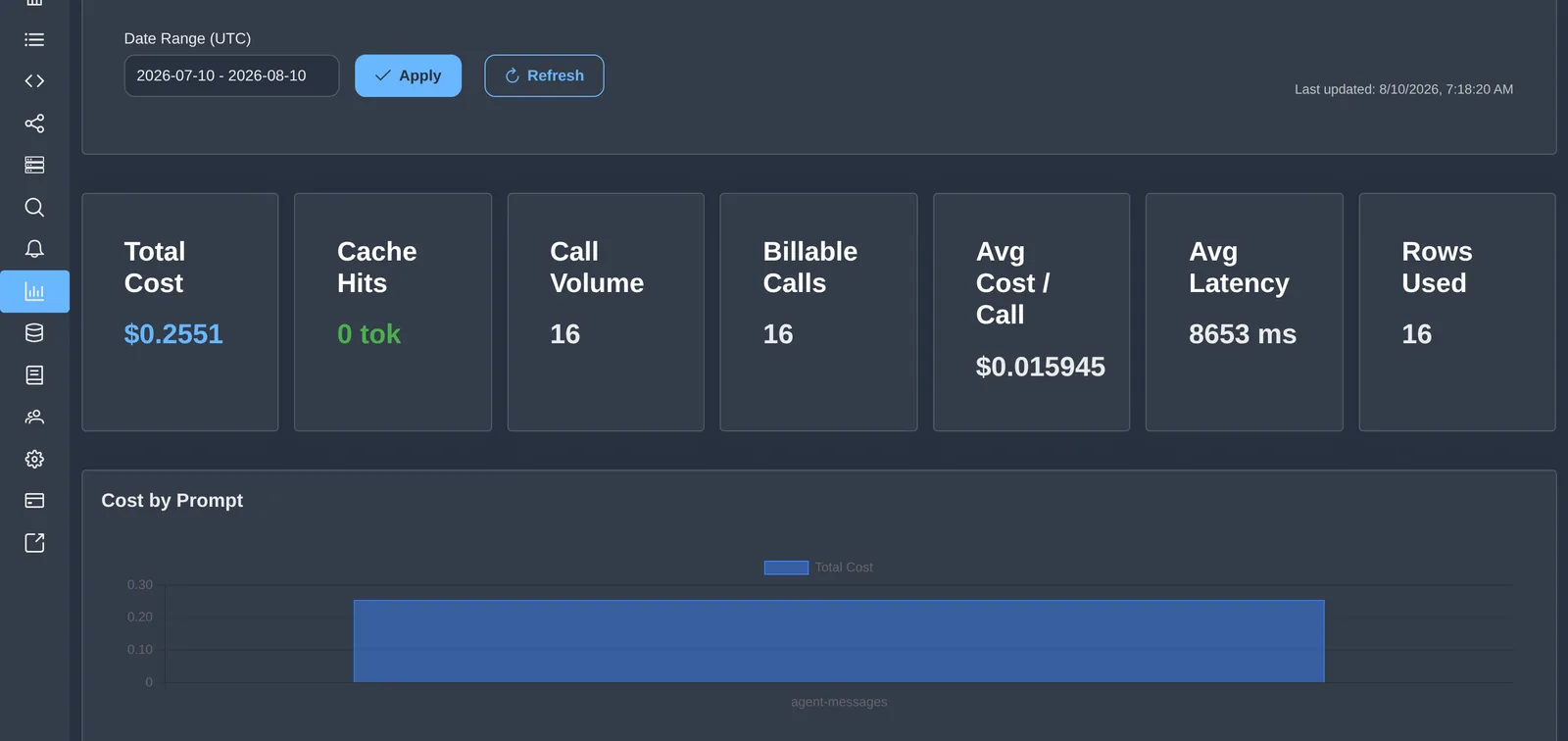
Cost and cache-hit analytics quantify exactly what compression is saving you per prompt.
Compression is lossless: the model receives every value it would have in the verbose form — you're only removing repeated structure.
Ship on this — free to start.
Author a prompt once and call it by name. VernaOne handles the model, the fallback, the cost, and the alerting.
Launch VernaOne →Frequently asked
Is the compression lossless?
Yes. The columnar transform restates the same data with each key declared once instead of per-record. The model receives all the values; only the repeated structure is removed.
How much does it actually save?
On data-heavy prompts — arrays of records, large JSON payloads — savings are typically 28–49% of input tokens. Prompts that are mostly prose see less, because there's less structural overhead to remove.
Do I have to change my prompts?
No. Compaction, output shaping, and cache alignment are options VernaOne applies around your existing prompt; you keep authoring prompts normally.