NEW Route to the cheapest model that passes — see how →
Every model. One API. Versioned, governed, cheaper.
VernaOne is the layer between your app and every LLM — a router in the request path,
a versioned prompt registry, and cost + quality analytics in one.
One tool instead of five. And because it sits in the path, it doesn’t just show you the bill —
it lowers it.
✓ Bring your own keys — routing free✓ No per-trace tax✓ No per-seat lock-in
app.ts
// Before — welded to one provider, one model, one priceconst res = await openai.chat.completions.create({
model: "gpt-4o",
response_format: { type: "json_object" }, // OpenAI-only
messages: [ ...hardcodedPrompt ]
})
// With VernaOne — one call; routes to the cheapest model that passesconst res = await verna.run("summarize-ticket", { ticket })
// fallback, cost routing & version pinning in config — no code change
One API in the request path in front of every model and tool you already use
Teams buy a gateway to route, an observability tool to watch, and a prompt store to remember — three products that don’t overlap. The intersection is nearly empty. That’s where VernaOne lives.
AI gateways
Helicone · Portkey · LiteLLM
In the path, but blind
In the request path
Routing & fallback
Can act on cost
No prompt registry
No studio / evals
No version history
Observability & eval
Langfuse · LangSmith · Braintrust
Watching, but powerless
Traces & analytics
Prompt mgmt (a feature)
Offline evals
Not in the request path
Can report cost, not cut it
No routing or fallback
VernaOneyou are here
The overlap nobody else fills
In the path AND the source of truth
Router in the request path
Versioned prompt registry
Cost + quality analytics
Active cost control
Compare · optimize · promote
Gateways are in the path but blind. Observability tools watch but can’t act.
VernaOne is in the request path and the source of truth — so it can route, remember, and observe in one call.
Active cost control
Everyone shows you the bill. VernaOne lowers it.
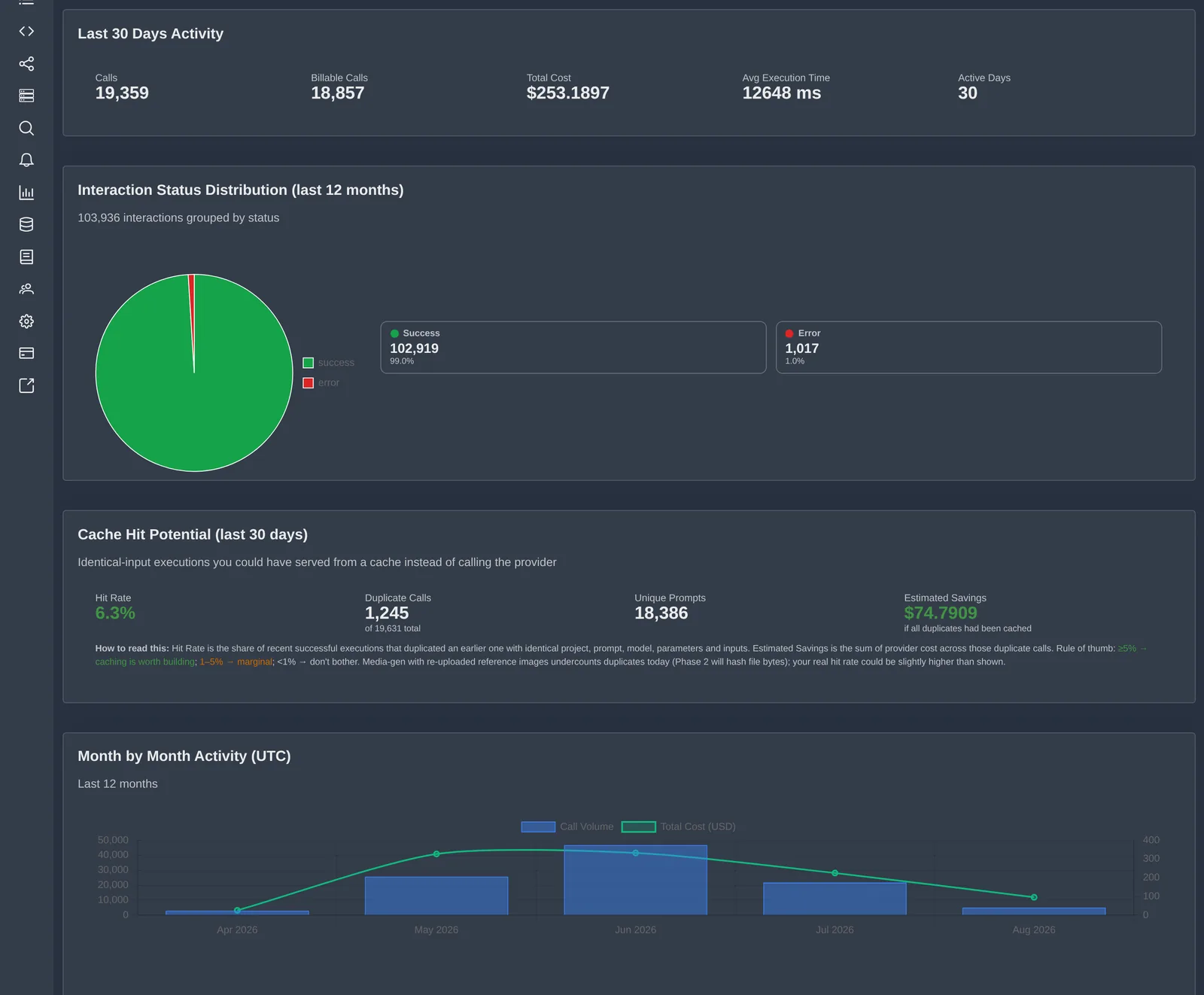
Cost control on your LLM usage is only possible from inside the request path. Observability tools sit beside it — they can attribute spend, never reduce it.
Cost reporting — the observability camp
Passive. After the fact.
Shows what each call cost, by model and prompt
Dashboards you read after the money is spent
Not in the path — cannot change a single request
Cost control — VernaOne
In the path. Acts on every call.
Routes to the cheapest model that passes your quality checks
Fails over automatically instead of paying premium retries
Compresses input tokens losslessly — 28–49% on data-heavy prompts
Reuses cache & dedup hits before they ever reach a provider
Cheaper without getting worse
Cost routing is gated by your eval checks — a call only drops to a cheaper model if it still passes. Cost and quality are decided together, in the same request, so lowering spend never quietly lowers quality.
The data behind it
We track every model on the market — and price it daily.
Routing to the cheapest model that still passes your checks only works if something knows what everything costs, today. That is a live index of 1502 models from 86 companies, rebuilt every day and read straight from the sellers.
1502models indexed
806with a published price
74sellers compared
72quality-tested by us
How it is built
Read from source, every day.
Prices from the sellers themselves — provider APIs and the vendors' own pricing pages, not a scraped aggregator
Every figure carries its source and how strong that source is, so you can check any number we publish
Compared like for like — same job, same billing unit, same service tier. A batch rate never stands in for an on-demand one
Quality measured by us, at temperature zero with deterministic checks — no leaderboards, no vendor claims
What it does for your bill
In the request path, not in a report.
Finds the cheaper equivalent for a model you already use, and tells you what you give up
Catches price cuts and rises the day they happen, across every provider serving your models
Flags deprecations before an endpoint disappears underneath you
Feeds the router directly — the same data that powers the comparison decides where your calls go
Independent by construction
We sell a router, and the index still lists the routers we compete with. It has to: an index
that quietly omits a seller is not an index. Prices are published with the evidence behind
them, disagreements between sources are shown rather than resolved in our favour, and where
we cannot verify something we say so. Last rebuilt 2026-09-11.
Call a named prompt and VernaOne routes it — to an LLM, a media model, live web search, or a web scraper — with automatic fallback across providers, all from inside the request path.
Live web search (Tavily, Perplexity) and web scraping (Scrappey)
Media generation — image, video, audio, music
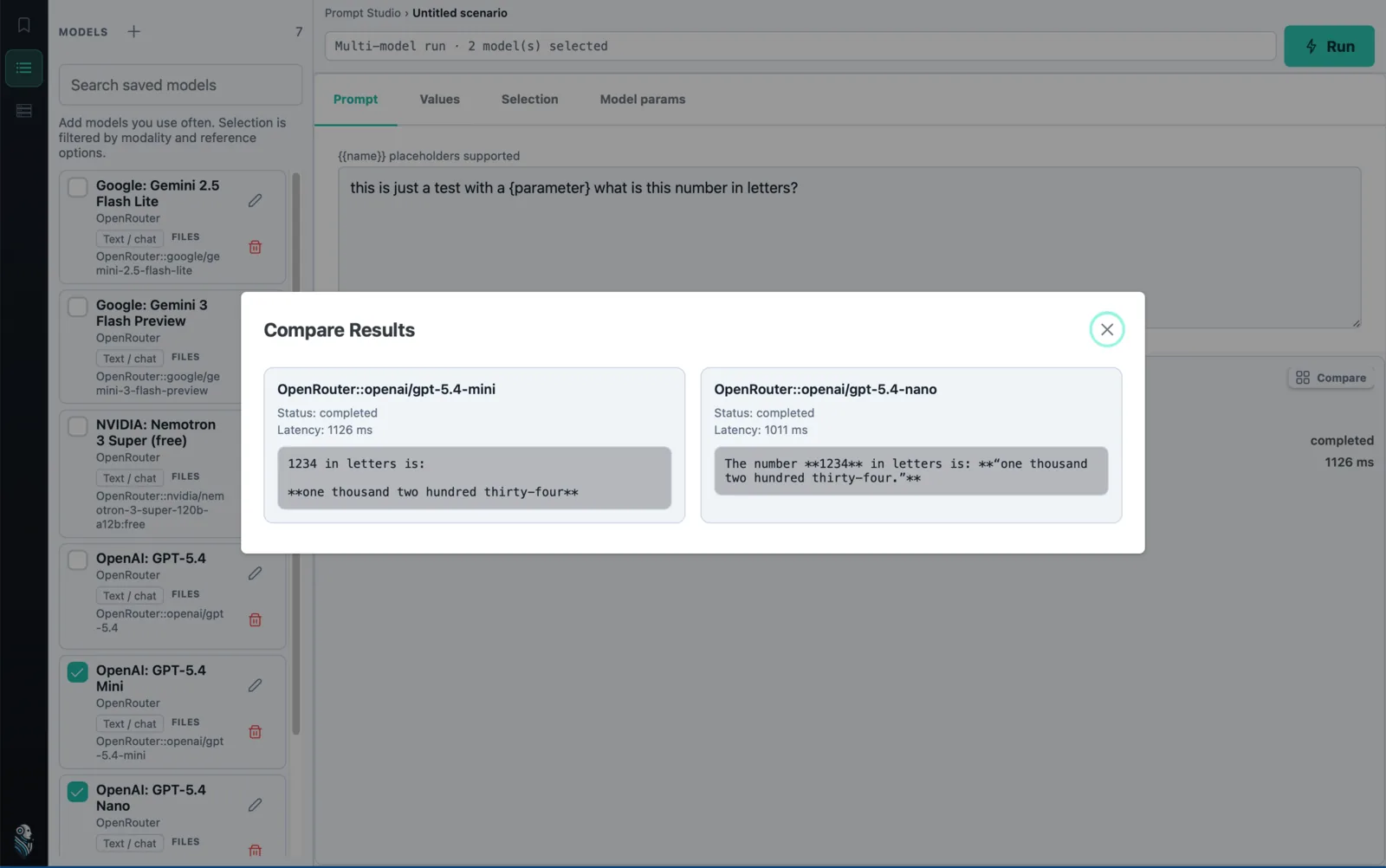
Compare & choose
Run one prompt across every model.
Pick your models, hit run, and see each one’s output, latency, and cost side by side. Choose the winner with hard data — then promote it to the versioned endpoint your app already calls.
Parallel multi-model runs with a results matrix
Latency and cost per model, per run
Promote the winner — test and prod are the same object
VernaOne is the runtime layer between your app and every LLM. It combines three things teams normally buy separately: a multi-provider router that sits in the request path (routing, fallback, cost control), a versioned prompt registry (prompts as named, model-agnostic endpoints), and cost + quality analytics on top. One tool instead of five.
How is VernaOne different from Langfuse, LangSmith, Helicone, or LiteLLM?
Those tools each cover one layer. Gateways like Helicone, Portkey and LiteLLM sit in the request path and route, but have no prompt registry or studio. Observability and eval tools like Langfuse, LangSmith and Braintrust watch your calls after the fact — they can report cost, but they are not in the request path, so they cannot act on it. VernaOne is in the path AND the source of truth: it routes, remembers, and observes in one place.
How does VernaOne lower my LLM costs?
Because it runs in the request path, it can act on cost, not just report it: route each call to the cheapest model that passes your quality checks, fail over automatically instead of paying premium retries, compress input tokens losslessly (28–49% on data-heavy prompts), and reuse cache/dedup hits. Observability tools can only show you the bill after it is spent.
Does cost routing hurt quality?
No — routing is gated by your eval checks. VernaOne only moves a call to a cheaper model if it passes the checks you set, so you get cheaper without getting worse. Cost and quality are decided together, in the same request.
Which providers and tools does VernaOne support?
OpenAI, Anthropic, Google, xAI, DeepSeek, Mistral, Groq, Cohere and Perplexity, plus OpenRouter — behind one API. It also reaches media models (fal, Replicate, Mureka) and tools (Tavily search, Scrappey scraping). You call a named prompt; VernaOne routes it and falls back across providers on failure.
Is there a free version?
Yes — a free tier and a free desktop app. Bring your own provider keys and routing is free, with a monthly execution allowance on every plan. There are also free tools like the Prompt Auditor, Portability Linter, and Cost Calculator, with no signup.
We use a functional cookie to remember your theme, and — only if you accept — privacy-friendly
analytics to understand what's useful. See our Cookie Policy and
Privacy Policy.