One API for every model — and tool
One API for every model and tool.
Each provider has its own SDK, auth, request shape, and response quirks. VernaOne puts all of them — LLMs, media models, live web search, and web scraping — behind one prompt-centric API, so you build the integration once and add any capability without new glue.
Try VernaOne free → ← All features
~15 providers & tools behind one API — LLMs, media, search & scraping




N providers means N integrations
Adding a new model usually means a new SDK, new auth, new error handling, and new response parsing. Comparing two providers means writing two integrations. The cost of trying anything new is high, so teams get locked into whatever they started with.
That lock-in is expensive precisely when a cheaper or better model shows up and you can't easily switch.
How the router works
- 1
One request shape
Call any model — OpenAI, Anthropic, Google, OpenRouter, xAI, DeepSeek, Mistral, Groq, Cohere, Perplexity — through the same API, keyed by your prompt, not a vendor SDK.
- 2
Beyond text
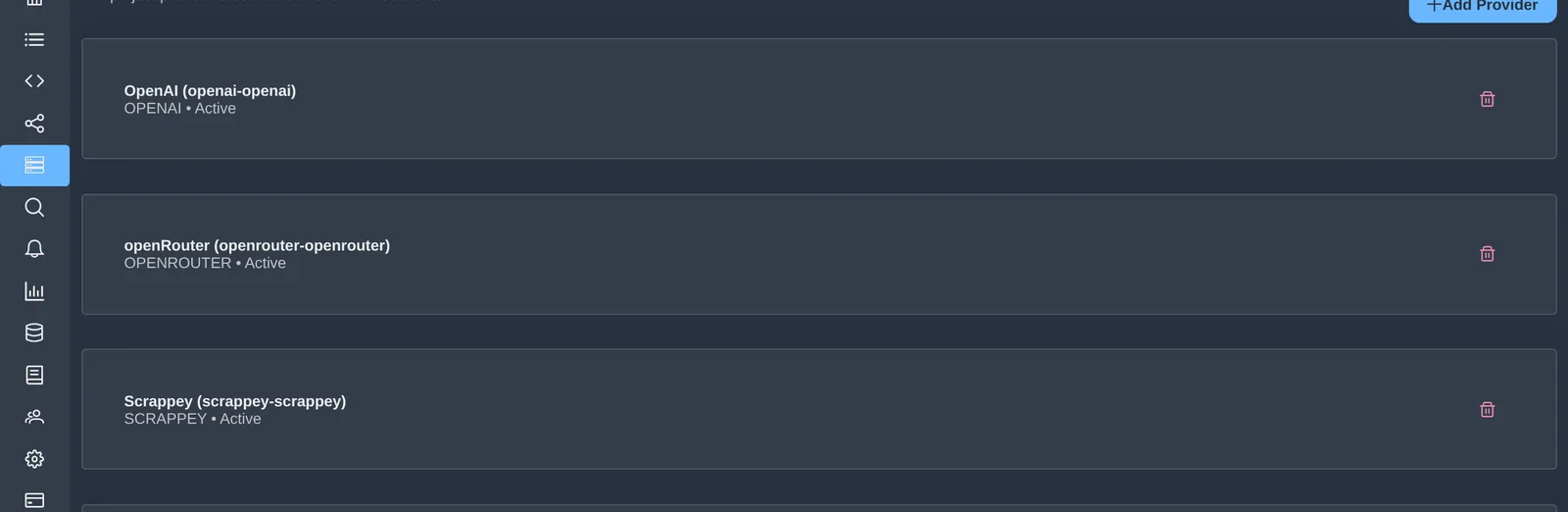
The same API also reaches media generation (fal, Replicate, Mureka), live web search (Tavily, Perplexity), web scraping (Scrappey), and embeddings — one integration for every capability.
- 3
Unified response envelope
Text or media, sync or async, every execution returns the same predictable shape, so your code handles any model or tool identically.
- 4
Bring your own keys
Connect your own provider accounts, stored encrypted and scoped per project, so you keep control of billing and rate limits while gaining one API.
Highlights
~15 providers & tools
LLMs, media, search, and scraping — one API surface for all of them.
Unified envelope
The same response shape everywhere; no per-vendor branching in your code.
Bring-your-own-key
Your provider accounts, encrypted and project-scoped — you keep billing control.
No lock-in
Switch or blend providers by config, not by rewriting integrations.
Because your code references a prompt name — never a vendor SDK or a hardcoded model id — changing models is a configuration change, not a code change.
Ship on this — free to start.
Author a prompt once and call it by name. VernaOne handles the model, the fallback, the cost, and the alerting.
Launch VernaOne →Frequently asked
Which providers does VernaOne support?
OpenAI, Anthropic, Google, OpenRouter, xAI, DeepSeek, Mistral, Groq, Cohere, and Perplexity for text; fal, Replicate, and Mureka for media; and Tavily and Scrappey for search and scraping — around 15 providers and tools behind one API.
Do I use my own API keys?
Yes. VernaOne is bring-your-own-key: you connect your own provider accounts, stored encrypted and scoped to your project, so you keep control of billing and rate limits.
How do media and text share one API?
Every execution — text or media, sync or async — returns the same response envelope, so your code handles a video generation the same way it handles a chat completion.